Opponent wants much higher gas taxes
My Opponent, Gamba, wants the state gas tax to go up 5 cents per year, doubling to 80 cents

The Oregon Legislature and Governor passed a bill that would have increased the state gas tax to 45 cents from 40 cents this year, which would have made Oregon the 11th highest in state gasoline taxes among the 50 U.S states. Voters rejected this increase in the gas tax in May of 2026 by 83% voting no, and so, the state gas tax remains at 40 cents and 13th highest in the nation.
My opponent Gamba is part of a group that proposed hiking the gas tax each year by 5 cents until it reached 80 cents, doubling it by the year 2032. Here's the link which stems from an original report by the Oregon Public Broadcasting news website: Progressive Democrats unveil plan for transportation funding driven by doubling of gas tax | News From The States
In this article, just linked, Gamba is quoted as saying Oregon spends less on transportation per person than other surrounding states. But a fact check, using Willamette Week news, says Oregon spends about average on transportation per person compared, nationally and against other western states. Here is Google's Artificial Intelligence fact check of Gamba's under spending claim:
______________________________________________________________________________________________________ Overview No, Oregon's spending on roads and highways is about average compared to other states. [1, 2]Spending Levels
- Average comparison: Analyses by groups like the Brookings Institution and the Oregon Department of Justice show that Oregon spends roughly average amounts per capita on roads and highways compared to neighboring Western states (around $630 per resident). [1, 2]
- Misconceptions: Claims that Oregon is a uniquely low-spending state often confuse transportation revenue, taxes, and fees with actual project spending, or fail to account for how other states handle car-related sales taxes through general funds. [1, 2]
_______________________________________________________________________________________________________
My own view is that Oregon state government is not controlling its costs. Both the Rose Quarter I-5 and Interstate Bridge Replacement projects need to be streamlined, and the billions in tax dollars flowing to them should be cut to just cover maintenance of the existing Rose Quarter I-5 freeway and the Interstate Bridge just simply be earthquake proofed. Oregon must also look to more competitive bidding for its road maintenance and operations, rather than making these costs fixed at highest rates.
(posted by Elvis Clark September 29, 2026)
Gamba wants you to pay A Lot more in property taxes
As Mayor, Gamba pushed Milwaukie's Budget Committee to include this chart in the City's budget doc.
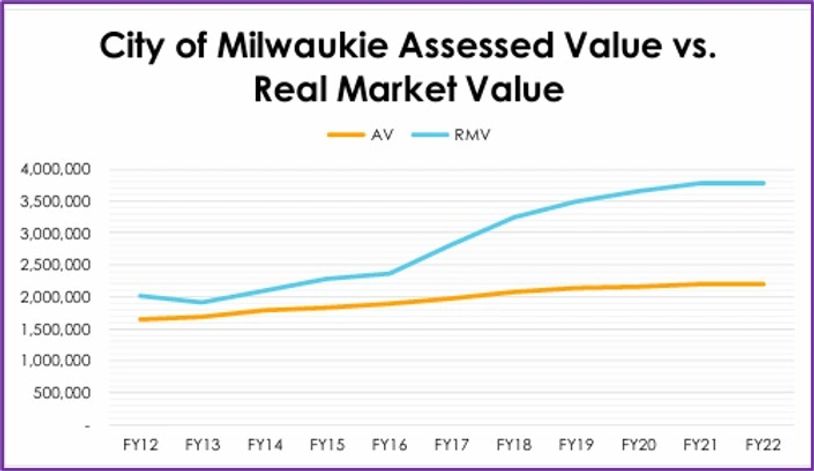
Gamba wanted the above chart to be included and put upfront in Milwaukie's Budget document, bemoaning the fact that if only Oregon's constitutional limits on increases in property taxes were abolished, Milwaukie city hall could rake in more property tax proceeds from homeowners/property owners. Property taxpayers in Oregon, including Milwaukie, pay property taxes based on the assessed value (AV) of their home (the lower gold line in the chart above), but Gamba wants to tax property owners based on the real market value (RMV) of their homes (the much higher blue line).
Hence, if Gamba had his way, your property tax bill would be over 50% per year higher than it is now - you would be taxed on the blue line of the chart above rather than the constitutionally limited gold line. (The chart above might be a bit confusing as the top blue line is the real market value of all homes and properties in the City of Milwaukie and the bottom gold line is the constitutionally limited assessed value of all homes and properties in the City of Milwaukie. But make no mistake about it, your home is included in both lines.)
(If you are a renter, you also probably pay property taxes indirectly, as your landlord typically raises your rent by the amount that he/she pays in property tax on the apartment or home you are living in. So, property taxes do not just hit the wealthy as Gamba would have you believe, but most Oregonians pay - and would pay much more if Gamba had his way.)
Ironically, once Gamba left his mayoral position to become state representative, the City of Milwaukie discontinued showing the graph above, the one Gamba had insisted on.
(posted by Elvis Clark on September 20, 2026)
Gamba wants to do away with kicker tax refunds
In 2023, the average Oregon income taxpayer got their tax payment reduced by $1,000

Mark Gamba in his Voter Statement states the following: "...the kicker and property tax limits. Both predominantly benefit the richest Oregonians. " During the 2025 Oregon legislative session, Gamba sought to reduce the refund Oregon income taxpayers receive when the state over collects income taxes (it's called the Kicker Refund).
Gamba claims that the Kicker Refund benefits mostly just the wealthy, but the average Oregon income taxpayer in a recent year benefited by the tune of $1,000 in Kicker refund, lowering their actual state income taxes by the full $1,000. The Kicker helps many Oregonians keep more of their hard earned income.
Here's OPB's reporting on attempts by Gamba and other legislators to deny Oregon taxpayers the benefit of lower taxes when the state over collects income taxes: Oregon lawmakers might once again debate the ‘kicker’ tax rebate this year - OPB
Here's Oregon Catalyst's reporting on the kicker refund benefiting most Oregon taxpayers:
45% of your 2022 income taxes to be refunded (Kicker) | Oregon Catalyst
Gamba wants to raise your cost of living with another Tax
If it weren't enough, Gamba also wants to add a sales tax onto your cost of living.
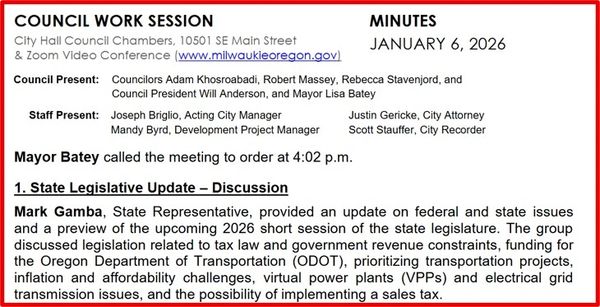
The above panel documents that as state representative Gamba wants a new statewide sales tax. This sales tax would make the lives of Oregonians significantly less affordable. Gamba told he supports a new statewide sales tax to Milwaukie city councilors back on January 6, of this year.
Gamba says the state needs a sales tax, but we already have a sales tax

As described in the above panel, the state of Oregon taxes business gross receipts, or in other words, sales. The state has what is called the CAT tax, which is short for Corporate Activity Tax. Oregonians pay more for the things they buy because the CAT tax is passed by businesses onto Oregon consumers, hidden in the sale prices of things Oregonians buy. Businesses normally pass along the CAT tax to Oregon consumers without it appearing as a separate line-item tax, as would be the case with a typical sales tax.
Google's Artificial Intelligence confirms the CAT tax as a sales tax:
_____________________
AI Overview
✅ Yes, Oregon's Corporate Activity Tax (CAT) applies to a large corporation's gross sales (specifically, Oregon-sourced commercial activity/gross receipts) over $1 million, though it allows a partial subtraction for certain costs.
______________________
So, Gamba wants to place a sales tax on top of an existing sales tax. It seems clear that Gamba's addiction for wanting more taxes would cause an acceleration of Oregonians and Oregon businesses who pay the state taxes, now, to pack up and leave the state, leaving less state monies to help those needing state assistance.
Too much taxes put Oregon in an economic doom loop, and even now more Oregon businesses are closing than opening.
I don't know how else to describe it, but Gamba is a horror show for everyday Oregonians - his wanting to hugely fund and grow an already bloated state government sharply raising taxes on everyday Oregonians, right down to those living just paycheck to paycheck.
(posted by Elvis Clark on October 4, 2026)
Gamba thinks he knows better than you how to use your money
A Recent DHM Poll of Oregonian concerns ranks the high cost of living and taxes as most dire
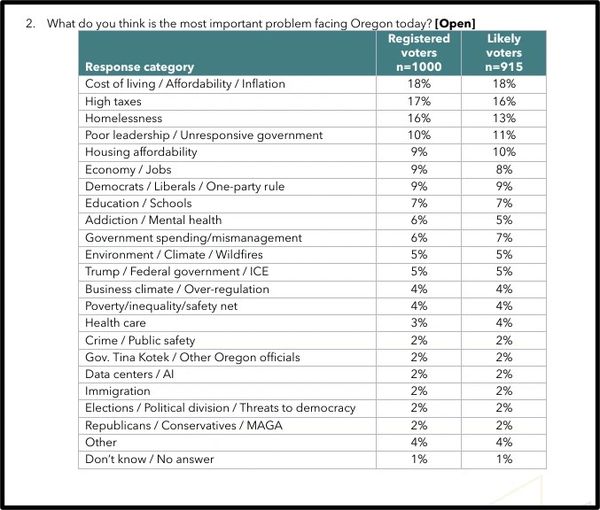
Gamba's want of a new state sales tax would worsen the cost of living, as the cost of goods and services would inflate further as businesses pass along this new sales tax onto you the consumer, via higher prices.
Gamba's want of faster property tax increases, lower state income tax refunds, and much higher gas prices would hit most Oregonians, not just the so-called wealthy.
Oregon already has the 9th highest tax burden among the 50 U.S states
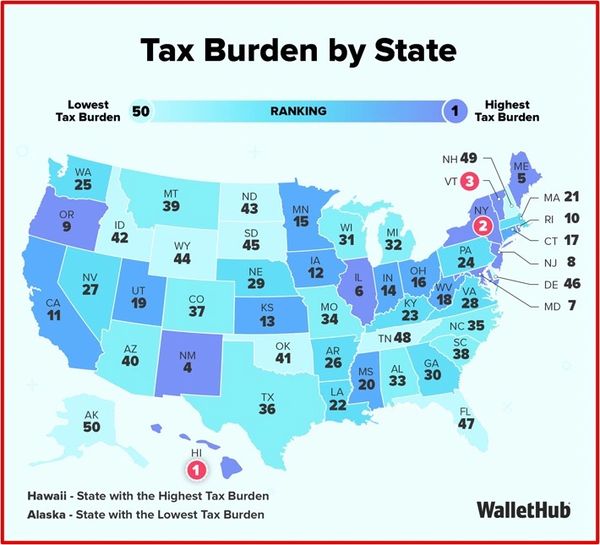
Wallet Hub's ranking above of Oregon as being the ninth most costly state for taxation is also shared by the federal government's Bureau of Economic Analysis ranking of state income taxation. Wallet Hub's ranking includes sales, excise taxes in addition to income taxes.
State government is already ballooning in size, bleeding away the ability of Oregonians to afford it
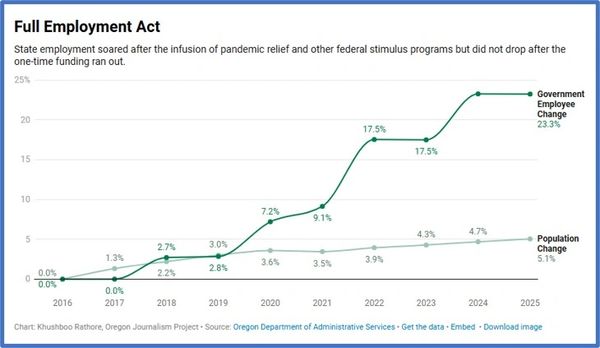
The chart just above put together by Willamette Week newspaper, back this last July 2026, shows that Oregon state government employment is growing sharply faster than the population of Oregon. This is true also of Oregon state government spending which outpaces growth in the Oregon economy over the last ten years, per data from the St Louis Federal Reserve bank.
In spite of Oregon's high tax burden, Gamba looks down on Oregon taxpayers, calling them petulant
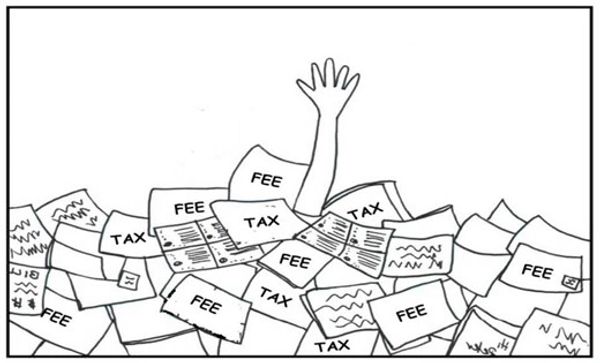
God's honest truth: Gamba called taxpayers - objecting to his proposed doubling of the state gas tax - petulant children, per OPB news reporting.
The reason Gamba (D) can ignore his constituents and hike their taxes and cost of living is that he is in a noncompetitive district, as voter registrations are over 5 Democrats to 1 Republican in Oregon state house district #41, the one I am seeking your vote.
I, Elvis Clark (R), nonetheless ask for your vote as my top priority is to vote against the creation of new taxes, fees; limiting the funding of Oregon state government to that provided by existing tax and fee rates. No new taxes.
If you really want to stop the state legislature from creating new taxes and fees, and/or hiking existing tax/fee rates; vote for gridlock among state legislators and the Governor, by voting Christine Drazan (R) for Oregon Governor.
(posted by Elvis Clark on October 5, 2026)
Oregon State Rep. Diehl says Oregon has enough tax momey
For Diehl,Oregon needs to do a way better job of prioritizing its spending, not seeking new taxes

The following is from state Representative Ed Diehl, writing about Oregon government's lack of competence and its inability to deliver on programs and not being able to prioritize its spending, and its continual lack of fiscal discipline and its continually looking for taxpayers to bail it out:


Friend,
Sometimes one person's story can expose everything that is wrong with a government system.
The Oregonian recently told the story of a formerly homeless Oregon woman who suffers from serious mental illness. Her story is ultimately one of hope. She found stability. She found housing. She is working.
But buried inside her story are three remarkable admissions about the systems that were supposed to help her.
She believes some people suffering from serious mental illness need a level of care they cannot obtain on their own.
“I think we should reinstate institutions to care for people who need more,” she said.
She also limits how much she works because earning too much could jeopardize the government health and disability benefits she depends upon.
And all of this is happening while Portland-area governments say they don't have enough money to keep hundreds of shelter beds open.
Put those three things together and you begin to see Oregon's real problem.
We don't necessarily lack money. We lack priorities.
Hundreds of millions for climate programs. Not enough for shelter beds.
Portland is reducing shelter spending as it deals with its budget shortfall.
At the same time, the Portland Clean Energy Community Benefits Fund is projected to begin FY 2026-27 with a fund balance of approximately $698 million.
Think about the scale of that number.
Nearly $700 million accumulated in a government climate fund while people suffering from serious mental illness are sleeping on Portland's streets and the city says it cannot afford existing shelter capacity.
That doesn't mean every dollar of that $698 million is uncommitted or can legally be transferred to shelters tomorrow. Much of it is dedicated to grants, contracts and future expenditures.
But government created those priorities.
And Portland has already demonstrated that the wall around this money isn't absolute. This year the city transferred approximately $27 million of PCEF interest earnings into its General Fund.
Apparently dedicated money can become flexible when elected officials decide it needs to be.
The question isn't whether we should empty the climate fund tomorrow.
The question is simpler:
How did we create a government where accumulating hundreds of millions for future climate programs takes precedence over keeping vulnerable human beings off the streets today?
More than half a billion dollars saved for future preschool expansion
Cross the governmental boundary from the City of Portland to Multnomah County and the numbers are just as extraordinary.
Multnomah County's Preschool for All program has accumulated approximately $514 million in "Dedicated Savings." Add approximately $47 million in contingency and reserves and the number exceeds $560 million.
Again, that money isn't an accounting accident.
It is intentional.
Multnomah County designed the program to collect more taxes than it currently needs and bank the excess to pay for preschool expansion in future years.
There may be arguments for doing that.
But there is also a moral question that shouldn't be ignored.
Should government collect taxes today and warehouse more than half a billion dollars for services it plans to provide years from now while cutting shelter capacity for desperate people who need help tonight?
You don't have to oppose preschool to believe the answer is no.
Government is about priorities.
And budgets reveal those priorities better than speeches ever will.
Then there's the money that was actually supposed to solve homelessness
The third pot of money may be the most troubling.
Metro's Supportive Housing Services tax was specifically created to address homelessness.
During its first three fiscal years, the program collected approximately $592 million.
Yet Metro's auditor found that only about 40% of the tax revenue collected during those years had been spent.
The result?
An accumulated fund balance of approximately $354 million.
To be clear, that is a historical figure, not the current balance. Governments have subsequently spent down much of that accumulated money.
But that raises an entirely different question.
How does a region collect so much money specifically for homelessness that it accumulates $354 million it cannot deploy — and then, just a few years later, find itself closing shelter beds?
That's not a revenue problem.
That's a management problem.
It's a priorities problem.
And ultimately it's an accountability problem.
Then listen to the woman we're supposedly trying to help

The most powerful part of this story isn't actually the money.
It's what this woman says about mental illness.
After living through serious mental illness and homelessness herself, she recognizes something Oregon policymakers have been reluctant to acknowledge:
Some people are simply too sick to seek the treatment they need on their own.
For decades, the dominant philosophy has been deinstitutionalization and community-based treatment.
Organizations such as Disability Rights Oregon continue to make preventing institutionalization an explicit priority.
Community treatment absolutely should be the first choice for people capable of succeeding with it.
But what about the person experiencing psychosis who doesn't believe he is sick?
What about the woman incapable of keeping an appointment, taking her medication or even recognizing that she needs help?
What about the person cycling endlessly between a sidewalk, an emergency room, a jail cell and back to the sidewalk?
Calling that "freedom" isn't compassionate.
Sometimes compassion means intervening.
Even NAMI has begun to recognize that
This debate has changed substantially in just a few years.
I know because I've been part of it.
In 2023, I tried working with NAMI Oregon on civil-commitment reforms. At that time, there was substantial resistance to expanding involuntary treatment, including from organizations within the mental-health advocacy community.
NAMI's position has since evolved.
By late 2024, NAMI Oregon publicly acknowledged how difficult this issue had been within its own membership. Executive Director Chris Bouneff described civil commitment as a "tightrope" and said it wasn't an issue on which he originally wanted NAMI to lead.
But NAMI also acknowledged the reality staring Oregon in the face:
Our current system often waits until someone suffering from serious mental illness commits a crime before government intervenes.
So in 2025 NAMI Oregon did something significant.
It sponsored legislation to lower Oregon's criteria for civil commitment.
That evolution shows that experience is forcing people across the ideological spectrum to reconsider the assumptions behind Oregon's mental-health system.
We don't need to recreate the horrific institutions of generations past.
We need a continuum of care.
Community treatment whenever possible.
Intensive outpatient treatment when necessary.
Secure residential treatment for those who need it.
Adequate psychiatric hospital beds.
And, for the relatively small number of people whose illness has rendered them incapable of recognizing their own condition or caring for themselves, a humane civil-commitment system that allows us to intervene before they end up in jail, dead or living under a tarp.
That isn't abandoning civil liberties.
It's recognizing that serious mental illness can sometimes rob a person of the ability to exercise those liberties meaningfully.
And then government tells her not to work too much
Finally, consider what happens when someone actually makes it through this broken system.
This woman got stable.
She found housing.
She began working.
That's exactly the outcome taxpayers should want.
And then she encountered another government-created problem.
If she earns too much, she risks losing health coverage and disability benefits she depends upon.
So she limits her work.
She's responding rationally to the incentives government created.
Think about how backwards that is.
We spend enormous sums trying to move someone from homelessness toward stability.
Then, when she succeeds, we create a financial incentive for her not to become fully independent.
A rational safety net should work in the opposite direction.
Benefits should phase out gradually as someone's income rises. Working another hour should always leave a person better off, not threaten the medical care or stability that allowed her to work in the first place.
Government should provide a ladder.
We've built a cliff.
Put people before programs
That's what makes this woman's story so important.
She isn't a line item in a government budget.
She's the person all of these programs supposedly exist to help.
And look at what we've built around her.
A city cutting shelter capacity while its climate program carries an enormous accumulated balance.
A county cutting homelessness services while deliberately saving more than half a billion dollars for future preschool expansion.
A regional homelessness program that once accumulated $354 million because government couldn't deploy the money fast enough.
A mental-health system that too often waits for someone to deteriorate until the criminal-justice system intervenes.
And a disability system that can punish someone financially for working more after she finally gets back on her feet.
Oregon taxpayers are extraordinarily generous.
The answer cannot always be another tax.
Before government asks working families for another dollar, we should demand that it put first things first.
Keep emergency shelters available for people who need them.
Build enough psychiatric and secure residential capacity to treat people with serious mental illness.
Fix Oregon's civil-commitment laws so families don't have to wait for a loved one to commit a crime before getting meaningful help.
Reform benefit cliffs so work and independence are rewarded rather than punished.
And take a hard look at the hundreds of millions of dollars accumulating in dedicated government accounts while basic human needs go unmet.
We don't need to choose between compassion and fiscal responsibility.
Real compassion demands fiscal responsibility.
Because every dollar government warehouses, wastes or spends on a lower priority is a dollar that isn't available for the person sleeping outside tonight.
This woman's story proves there is hope.
Now Oregon government needs to get its priorities straight.
Thank you for taking the time to read and stay engaged. I’ll continue working to bring common sense, accountability, and transparency to Salem, and I’ll keep you informed about the issues that matter to our communities and our state.
Thank you for the opportunity to serve you.
In Liberty
(posted by Elvis Clark on October 9, 2026)