Reining in city government. Case of Ashland Oregon
Voters in Ashland may vote to require voter approval of future taxes/fees. Milwaukie next?
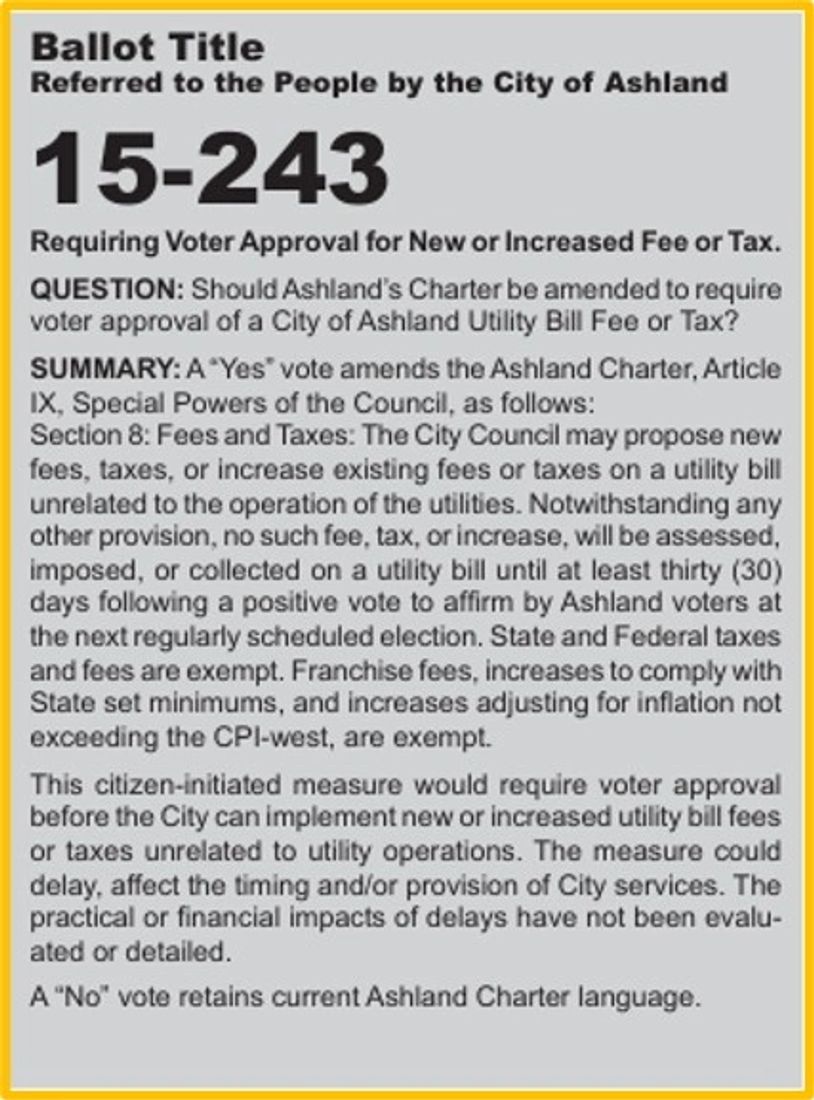
This provides me a template for working towards getting a ballot measure that would require Milwaukie City Council to gain voter approval of any new taxes and/or fees that it wants. In the past 2 years, Milwaukie City Council has enacted a new tax on your gas and electric utility bills, and a "safety" fee on water bills. These are enacted without voter approval.
The city of Milwaukie does not seem to be able to control its personnel costs which are escalating at over 5% per year consistently. It is losing basic service monies (the General Fund monies) to an oversized urban renewal district. It is spending a lot on a climate czar and equity director, with the latter only something created in the past couple of years. Climate and equity might be nice if you are flush in monies, but this is not presently the case for Milwaukie.
So, I aim to pursue getting Milwaukieans the right to vote on new taxes/fees in the year ahead, hoping to use the City of Ashland Measure - explained in the gold color border above.
Stay tune.
(posted by Elvis Clark on October 12, 2026)
Venture capitalist files some rather bold ballot initiatives
I am not sure how rich this fund manager is, but he hires a consultant to help with his initiatives
Photo to right of here is of John Von Schlegell, founder and manager of Endeavor Capital; and Schlegell files 11 initiative petitions for next year's November 2026 General Election. The petitions first need to be signed by 1,000 qualified Oregon voters, before the next step which is to get a title and constitutionality review by the Oregon Attorney General's Office and the Oregon Supreme Court.
Here is a list of the top four of Schlegell petitions, which Republicans would no doubt support:
1. Add more land for housing development (currently, Oregon pushes tiny homes/apartments for population infilling, risking the small-town nature of cities like Milwaukie, Oregon with more infill than otherwise would occur. This, while 98% of Oregon remains undeveloped and off limits to the building of new cities - like those new cities that could be built around new technologies, like dedicated lanes for small electric vehicles and drone corridors.)
2. Ban both corporations and unions from making campaign contributions (why is this attractive to Republicans? Mostly, it is that the state's public employee unions make it very difficult for Republicans to run for office, as Republicans tend to want to bargain harder and ask for more efficiency from public employee unions. Not sure this Schlegell petition is full proof as both corporations and public employee unions seem adept at circumventing any restrictions on their campaign donations.)
3. Ten-year sunset on new taxes and fees (here again, there is a good chance the intent is circumvented by the Oregon legislature and governor.)
4. Two-thirds majority vote of the public (supermajority) required for ballot measures that raise taxes (wow, schools and local governments already scream against the property tax limits 5 and 50, for supposedly causing them to be underfunded).
Here's the Willamette Week's reporting on Schlegell's initiative petitions:
Longtime Investor Files 11 Initiatives for the 2026 Ballot
Initiative Petitions have become very difficult to get on the ballot, because the Oregon legislature in the last decade or so has made the Oregon Attorney General Office (AG) and the Oregon Supreme Court the ultimate overlords in the titling of ballot measures. Ballot titles and there meaning have been often turned on their head by the AG and Oregon Supreme Court, both of which are owned by the Democrat Party which is beholden to those that fund - and volunteer for - its party politicians - namely, the Democrat Party is owned by the Public Employee Unions of Oregon and also corporate carpet baggers looking to make bank off of the public's monies, not to mention the administrators of "non-profit" government organizations (NGOs).
Grass root ballot initiatives are especially impossible these days, unless supported by state public employee unions, as the cost of paying signature gatherers requires millions of dollars - which most grass root petitioners have no access to.
Grass root volunteer (unpaid) signature gatherers, by contrast, mostly collect signatures during May through August at fairs and farmer markets. But these events cannot bring enough signatures to allow the grass root initiatives to qualify for the ballot. And so, paid signature gatherers are nearly a must for most grass roots initiatives.
But maybe this venture capitalist, Schlegell, has enough financing to employ paid signature gatherers. But he has only until next June 30th to collect hundreds of thousands of signatures. Republican volunteers could help, but the best opportunities for volunteer signature gatherers comes in June through August at fairs and farmer markets; and with June 30th 2026 as the cutoff date, seems rather skeptical that Schlegell will get any of his petitions on the ballot for next November 2026 General Election.
(posted by Elvis Clark on November 9, 2025)

Milwaukie council may add a new water bill fee
Word is Milwaukie considers adding a fee to fund its police department
There is a growing trend for city councils like Milwaukie City Council to get around the voters by enacting fees onto water and other utility bills - bills that their residents pay. Here is KGW's news reporting on this trend:
Oregon cities fill budget gaps with utility fees, often bypassing voter approval | kgw.com
Property tax increases generally require voter approval whereas fees can be enacted by a simple majority of the City Councilors - or, 3 of 5 Councilors voting yes to fee increases.
Milwaukie Council became interested in enacting a new property tax or a new fee when this last year Milwaukie's finance department forecasts revenue shortfalls for funding basic services - like the Milwaukie police department. Last year's finance forecast for the city of Milwaukie projected shortages for funding basic services beginning in the year 2027. But the latest financial projections show surpluses in basic service funds until the year 2029.
But Milwaukie Council still might consider adding a fee in the next year to fund its police department so as to free up its basic service funds to spend even more on "affordable" housing and economic development.
I have testified to Milwaukie Council that it is already spending too much on economic development - what with its urban renewal district draining the basic service fund accounts by over a million dollars already. And affordable housing is kind of an oxymoron. The City taxes and/or place fees on housing; and then after taking these monies from its residents and making them less able to afford shelter; the City picks its favorites to shower the tax and fee proceeds on. Affordable housing is mostly a government run shell game.
(posted by Elvis Clark on February 14, 2025)

Oregonians forecast to receive modest kicker refund in 2026
Oregon forecasts about $1 billion in surplus tax revenues, allowing Oregon taxpayers small refund

Oregon's state economist forecasts about $1 billion in extra revenues, to be refunded to state taxpayers in 2026 in the form of the Kicker refund (which is shown on the Oregon personal income tax form framed above in green border). The average refund, or refundable Kicker credit against taxes, for each Oregon tax filer with median income would be in a range of $100 to $200, in the 2026 tax filing season. This last tax filing season, April 2024, Oregon taxpayers had an average kicker refund credit against state taxes of $1,000.
So, the next kicker refund will be quite a bit smaller unless the surplus of Oregon state revenues continues to grow bigger this coming fiscal year (2024-2025).
But still, it is better than no refund.
Here's KOIN news reporting on the this latest 2026 Kicker refund estimate: Oregon revenue forecast shows Oregon out of pandemic lull, near $1B kicker (koin.com)
(posted by Elvis Clark on August 29, 2024)
Milwaukie tacks on a new 3% tax onto utility bills
The proceeds from this new tax won't help you, but will fund a new City Climate Czar.

You may have gotten the above notice from PGE electric utility, about a new City of Milwaukie utility tax/fee. This new fee/tax will show up on Milwaukie electric utility bills partially in July 2024, and fully in August 2024.
Up until 5 years ago, Milwaukie didn't have a Climate Czar/Sustainability director. But because other cities have Climate Change Bureaucrats pushing paper, I guess Milwaukie City Council can't resist joining this "green fad." And so now the average electricity customer in the City of Milwaukie will pay an extra $5.41 just to pretend like the City is cooling the earth with its hiring of a Climate/Sustainability Director.
Before, this new utility tax, the City Climate/Sustainability Director (Czar) and his/her consulting contracts (some $500,000 per year in total Climate Czar city expenses) have been funded out of City General Funds. But the City needs those General Fund monies now because its costs are increasing faster than its property tax proceeds - although part of the blame rests with City Council itself for spending more than need be on some non-basic service items (For example: Does the City actually need an Equity Director - A city employee position created in only the last four years)?
So, now the City of Milwaukie adds this new utility tax onto both PGE and Northwest Natural [gas] bills. The city still has a resolution on the books to force residents to switch from natural gas home heating and cooking to being all electric. The City Climate czar - that residents will now be taxed to fund - could end up working to take away natural gas utility service from residents, leaving residents totally dependent on one energy supplier - namely, the local monopoly PGE. How's this for a double whammy.
I argued before Council when it started considering this new utility tax, that the proceeds should be spent to help Milwaukie residents. For instance, the proceeds of this new tax could instead go towards giving out cash rebates to those city residents who plant and maintain a new shade tree (helping to provide relief for people on those hot summer days).
But nope. Council wants to pretend it is cooling the temperature of the earth by simply adding a Climate Change czar.
(posted by Elvis Clark on June 26, 2024)
MIlwaukie to raise electric and natural gas utility bills
The Milwaukie City Council is set to raise your PGE bill by at least $3 per month

In the above PGE electric utility bill excerpt, you can see that Milwaukie currently imposes a 1.5% tax on electric utility bills. (In the above bill excerpt, the Milwaukie PGE electric utility tax amounts to $2.02 per month.)
Starting this July 2024, Milwaukie City Council is set to add another 3 percentage points to its tax on PGE, such that the City of Milwaukie tax on monthly electric bills seems likely to increase by at least $3 per month - higher if you heat with electricity and not natural gas.
(posted by Elvis Clark on May 1, 2024)
Milwaukie City Council is also set to increase your Northwest Natural Bill by $2 or more per month

In the above Northwest Natural [gas utility] bill excerpt, Milwaukie currently taxes natural gas utility service at a rate of 2% - or in the above bill specifically, $1.68 per month.
This Milwaukie tax on gas utility bills is likely to increase by at least $2 per month, what with Milwaukie City Council's impending decision to raise its natural gas utility service tax to 5% from 2%.
This increase in electric and natural gas utility taxes is being spent by the city of Milwaukie to hire a Climate director, costing the city over $100,000 per year in employee costs, plus another $100,000 for materials and consulting services. The Climate director is likely to work on trying to eliminate energy choice for Milwaukie residents, making residents totally dependent on a more dominant PGE electric utility monopoly.
Milwaukie utility customers are paying twice for climate bureaucrats and programs. The Public Purpose Charge (in both of the above bill excerpts) funds Oregon state's "green" energy programs, and now Milwaukie's increase in utility taxes will pay for a City climate bureaucrat.
(See 'City Gov News' and 'City Hall News' for my written comment to the Milwaukie Budget Committee opposing the use of these increased utility tax monies for hiring a Climate director.)
Milwaukie moving to impose tree removal fees and fines
Milwaukie's Planning Commission on Tuesday (11/9) conducts hearing on private property tree removal
The following is a correspondence I get from Milwaukie's Urban Forester, Natalie Rogers:
"The Type 1 permits can be thought of as the ‘simple’ tree removal permits. These are tree removals for a variety of reasons listed in the type 1 approval criteria, including dead/dying trees, hazardous trees, significant infrastructure impacts etc. Type 1 removals do not incur additional fees – it’s just the application fee ($50) which may be waived in some circumstances. We decided to include in this approval list one healthy tree less than 18” per calendar year, meaning that property owners can remove a tree (<18”) as a type one permit with streamlined review. If they need to remove more trees, then a type 2 permit is required which is a little more work and may incur additional fees."
I believe I will want to argue, in my testimony, for waiving the removal permit fee for less than 18 inch diameter trees, on non-development private property homes; if property owner is maintaining four trees with diameters greater than 6 inches, in the case of wanting to remove one other tree with less than an 18 inch diameter.
I will post my testimony for modifying this proposed tree code on Saturday here.
(posted by Elvis Clark on November 4, 2021)