Oregon's On Fire. But this is nothing new for Oregon summers
Oregon timber harvesting/sales down sharply - boosting timber sales could raise firefighting monies

Randal O'Toole, who up until recently worked for the CATO Institute and previously represented environmental groups opposing U.S Forest policies as a researcher, writes that Oregon is naturally situated in a wildfire plain.
There is not a lot we can do to avoid wildfires and forest fires in Oregon and the Pacific Northwest. Dry summers east of the Cascades, and dry lightning storms make Oregon and the Pacific Northwest susceptible to wildfires and forest fires.
O'Toole writes that historical data on forest fires is fraught with problems, such that wildfire trends are very much not certain. Seems the Forest Service in the first half of the 20th century did a lot of prescribed burns, and the Forest Service included prescribed acre burns in the total for all burns.
Prescribed burns were not included in the data after the middle part of the 20th century.
In another twist, firefighters used to work right up to the wildfire line, but after the mid-1990s, firefighters worked farther back from the outer edge of wildfires.
We hear a lot about climate change being the cause of increased wildfires in the Pacific Northwest. The counter is that the sharp drop in timber harvesting has led to a buildup of woody debris in the forests, feeding larger wildfire burns. O'Toole dismisses the latter, saying wildfires are just plain unavoidable regardless of timber harvest levels.
But I would say that if we were to boost timber harvest by 50 to 100%, returning to 70% of the harvest levels of the 1960s through 1990s, that our forests could bring in several more tens of millions of dollars in tax proceeds (both timber tax and income tax) to help increase wildfire fighting resources. This would help tend to help fight wildfires more quickly and thoroughly than presently.
Currently, Oregon is growing new trees faster than they are being harvested, such that a boost in harvesting by 50 to 100% could be sustainable.
Also, wildfires that turn into forest fires often are started in summer-dried grasslands. Expanding grazing could help reduce grassland fires around forests. More goats?
Oregon Senator Merkley and Oregon Congressman Bentz are sponsoring a bill in Congress called the Wildfire Reduction Market act. The idea behind this bill is to turn the woody debris of U.S Forest lands into biomass fuel, which could boost monies for wildfire fighting and also reduce woody debris fueling forest fires.
Just blaming climate change for wildfires and demanding we ban all fossil fuels is really not much help at all in addressing wildfire risks. Even if we could arrest the increase in climatic temperatures immediately, wildfires are going to continue, as now and in natural history. Banning fossil fuels would likely lead to economic decline, which actually works against having adequate firefighting resources.
Rand O'Toole has quite the radical view about wildfires in the Pacific Northwest, some of which I do not agree, nor do many others agree. But O'Toole is worth a read, very educational on the topic of forestry and wildfires. I link to it here:
July-26-2-Whos-Responsible-for-Oregon-Wildfires_PDF.pdf
(posted by Elvis Clark on August 2, 2026) p.s it is my wife and my 30th anniversary, today.
Data Centers Should not be subsidized, nor banned
Data Centers speed research enabling faster drug discovery, medical treatments, traffic flow
Data Centers are a part of artificial intelligence (AI). Data Centers and AI seem destined to improve healthcare by getting to treatments and drug discovery faster. These two also seem likely to speed traffic flow by having vehicles share trip plans among commuters, in the aggregate and in real time, as drivers and their vehicles enter the public highway system. Then there is national security what with drone warfare adding a new twist to offensive and defensive warfare technology. (Hence, the U.S is in an AI race with China with big consequences for both winners and losers among these two superpowers.)
So, there are definite positives to Data Centers and AI. But at the same time, economic theory requires that Data Centers pay fully for their costs. Therefore, I do not and have not supported subsidizing Data Centers. Oregon has been doing this for more than a decade now.
These subsidies include state government economic development subsidies, local property tax exemptions, and utility rate payers paying increasing rates in what is called cross subsidies to Data Centers.
Oregon state government is only now getting around to stopping its subsidization of Data Centers - its recent law requiring data centers pay full cost for their power (HB 3546).
My major difference now with state law is that I would like to see Oregon loosen its energy policies and allow natural gas to compete with renewable energy to supply more energy to all Oregonians - this would include Data Centers having fuel/energy choice. Oregonians deserve fuel/energy choice.
Natural gas doesn't require overhead transmission lines as much as renewable energy sources. It does emit greenhouse gases, but renewable energy equipment is often made using diesel oil and coal power in Asia. Oregon, in part, is effectively shipping its greenhouse gas emissions to Asia. Global emissions do not change that much with Oregon's energy policies, which are called Net Zero.
(I do not see that Oregon's Net Zero policies are actually materially changing the trajectory of a warming planet - even after a decade of forcing renewable energy and replacing conventional natural gas power generation. Oregon's Net Zero policies may actually result in electricity shortages over the next several years, causing air conditioners to lose power during heat waves. The latter is a much more hurtful impact of Net Zero policies than any discernible benefit to the Oregon environment.)
A new advance in natural gas technology is fuel cells. Natural gas fuel cells are pretty efficient, achieving as much as 60 percent energy efficiency. Natural gas fuel cells also produce water as a byproduct of their power generation. Water is another resource intensely used by Data Centers for cooling - cooling the massive data center banks of silicon chips and power equipment. Oracle company is contracting for fuel cells to meet the power demands of one its mega data centers.
One thing to watch is whether new data centers are sized to be just under the size in Oregon's new state law requiring data centers to pay fully their costs. This law is called HB 3546 (The Power Act). The size in which data centers pay full cost is 20 megawatts or greater. But data centers can be split to be under 20 megawatts and avoid the requirements of HB3546.
Also, with data centers paying full cost, you probably will see new data center switching to new locations outside of Oregon. The downside to this is that high tech firms, such as Intel, might take their jobs to where these data centers are built, instead of Oregon. So, Oregon's economy may suffer substantively for pushing new data centers out of the state.
(posted by Elvis Clark on July 29, 2026)
Rank choice voting leads to one party rule - generally
The LA Mayoral race crystalizes why Oregon Democrat leaders support rank choice voting

In the November 2024 General Election, the Democrats of the Oregon legislature put Rank Choice voting on the ballot. Fortunately, in my opinion, Oregon voters voted it down.
What just happened in the Los Angeles Mayoral election illustrates why Oregon Democrats; for instance, state representative Mark Gamba; want and push for rank choice voting in place of Oregon's current Party primary election system. California and Los Angeles have a jungle primary system, which is not rank choice voting but still allows two people of the same party to end up going forward into the General Election - just as Rank Choice voting allows.
In the Los Angeles Mayoral election Sprencer Pratt, the leading Republican candidate, is edged into a third-place finish by Nithya Raman - a Progressive Democrat. Karen Bass, also a Progressive Democrat, finishes in first place. With Bass not receiving more than 50% of the total vote, Bass and Raman will now face off against each other in this coming November's General Election. So, 2 Progressive Democrats now become the only choice for voters in November. Whereas with Oregon's Party Primary system, generally voters get to choose between a Republican or a Democrat to represent them in a given district or jurisdiction.
The advantage of Oregon's Party of Primary system is voters get to hear and choose from two different approaches to government policy making. Republicans, in today's world, generally champion free markets and limited government; whereas Democrats tend to favor expanded Government and action.
Democrat voter registrations are generally greater than Republican registrations in Oregon, and so, rank choice voting would tend to favor having two Democrats running against each other in the General Election - rather than having the diversity of one Democrat squaring off against one Republican.
(posted by Elvis Clark on June 8, 2026)
Oregon's Clean Fuels program is a hidden tax on gasoline
Oregon's Clean Fuels Program costs Oregon gasoline users 9.35 cents per gallon of gas.
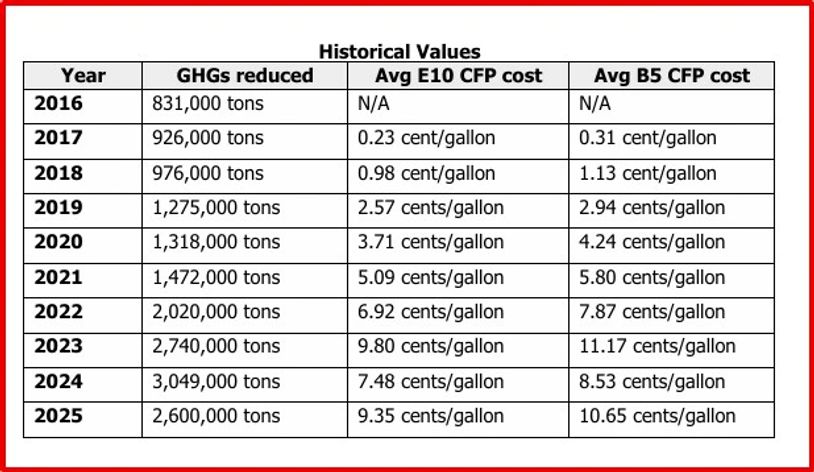
Oregon's Clean Fuels Program costs diesel users 10.65 cents per gallon (table above is published by the Oregon Dept. of Environmental Quality). The extra cost of Oregon's Clean Fuels Program is hidden from the end users, because gasoline and diesel wholesalers pay the cost. The extra cost of the Clean Fuels Program is scheduled, also, to rise sharply, at least for the next ten years.
The Clean Fuels Program is costing energy wholesalers over $150 million per year, and it is set to keep rising. Where does this $150 million plus in energy credit costs go? It goes to fund corn-based ethanol production, electric vehicle vendors, and "community environmental Justice."
The Oregon Department of Environmental Quality (DEQ) runs the Clean Fuels Program (CFP), and it says that the CFP reduces Oregon's greenhouse gas emissions by a mere 3 million tons per year, which is less than 1 tenth of 10,000 (.00005) of total global greenhouse gas emissions per year. And this is probably a large overstatement of actual greenhouse gas reduction, since the Oregon DEQ is ignoring the greenhouse gas intensive manufacturing process used to make electric vehicles and batteries.
Plus, there are credentialed environmental scientists who say that the CFP is causing deforestation of the Amazon and causing increased nitrate water pollution in the U.S corn belt.
The program is a laborious red tape exercise as well.
Cascade Policy Institute research organization recommends abolishing the Clean Fuels Program (CFP) and substituting the cost to gasoline and diesel fuel users of the CFP with a ten-cent increase in the gas tax - to help fill the Oregon Department of Transportation's road maintenance budget shortfall. This gas tax would be neutral for the cost of gasoline and diesel for users, as the hidden cost of the CFP would go away, resulting in no increase in the cost of gasoline and diesel.
If elected, I would vote to abolish the Oregon's Clean Fuels Program. But I would not increase the gasoline tax, except for indexing it to U.S consumer price inflation (the CPI). The Oregon Department of Transportation is overspending on big freeway projects, and savings from not overspending could be transferred to road maintenance.
(posted by Elvis Clark on May 21, 2026.)
Oregon facing electricity shortages. Natural gas can rescue
Natural gas power plants are reliable, affordable and yet Oregon fights against them

Northwest electric utility organizations report that Oregon is facing the increasing risk of electricity shortages. Even our state representative Gamba warns of coming electricity shortages - which is kind ironic because the increasing risk of electricity is the result of Gamba and other legislators/Governor blocking electric utilities from building new highly efficient natural gas power plants - plants that would run-around the clock and easily meet the rising demand for electricity in Oregon, preventing electricity shortages.
Electric utility engineers have been wanting to build new high efficiency, least cost natural gas power plants to meet rising electricity demand, for the last ten years. But they have been blocked by politicians like Gamba from building natural gas power plants, instead forcing electric utilities to become overly dependent on wind and solar farms, which only run part of the time - and thus may not produce enough electricity to meet the air conditioning needs of Oregonians in the inevitable heat wave or meet the heating needs of Oregonians in the inevitable cold spell.
In the chart above, which uses U.S Energy Information Administration natural gas price data for Washington and Oregon, it shows that the wholesale cost of natural gas - available for fueling natural gas power plants - is actually lower today than some 15 years ago now. And is about the same as ten years ago.
(The spike in natural gas prices in the year 2022 is due to the initial year of the ongoing Ukraine-Russian war. Within two years, the natural gas industry added enough production to overcome the export demand for natural gas (in the form of liquefied natural gas) caused by natural gas shortages in Europe in the initial year of the Ukraine conflict.)
Natural gas power is competitive with current PGE energy rates and can be added in volume

For high efficiency natural gas power plants, natural gas priced as it has been historically between $2 to $3 (excluding the Ukraine war caused spike), translates into a cost per kilowatt hour (KWH) of electricity of only 1 to 1.5 cents (as against the average PGE energy use charge of 3.54 cents per KWH cited in PGE's residential bill abstract above).
The cost of high efficiency natural gas power plant equipment itself adds about 2 to 3 cents on top of the fuel cost of 1 to 1.5 cents, making for a total wholesale cost of natural gas power (energy) of 3 to 4.5 cents per KWH.
The unsubsidized cost of wind power is around 10 cents while the unsubsidized cost of solar power is between 10 and 20 cents per KWH.
Of course, the obvious reliability problem with wind and solar is that these two power sources only run part of the time, and during that time when wind and solar are not producing much, there could be a heat wave or cold spell - causing a shortage of electricity for the air conditioning or heating needed to get through the heat wave or cold spell.
To solve the reliability problem of wind and solar, Gamba wants to build new greenfield electric transmission lines to access a more diverse set of wind and solar farms. But anyone who has worked for any length of time in the electricity business knows that it is nearly impossible to build new greenfield transmission lines in Oregon, because Oregonians object strongly to transmission lines crisscrossing the Oregon horizons.
The other solution for the solar and wind reliability problem is to build lots of battery storage complexes. But this is expensive, adding to electricity rates. Plus these large battery complexes could turn toxic for the surrounding area of the complex, as these batteries are known to sometimes explode and spew cancerous microscopic cobalt particles for miles.
Natural gas power plants can be located near existing transmission lines, such that new greenfield transmission corridors are not necessary. Natural gas power plants can also be located near urban areas where electricity demand is highest, cutting down the need for a lot of new transmission capacity.
Natural gas power is therefore the most straight forward solution to meeting rising electricity demand in Oregon. Natural gas power could actually be used to cut down greenhouse emissions, if it is used to displace gasoline and diesel used in passenger vehicles and light trucks via electric passenger vehicles and trucks.
Oracle company recently announced it is contracting for fuel cells, using natural gas, to generate around-the-clock power for its data centers. Fuel cells when producing power from natural gas actually also produce water as a byproduct - water being useful, critical for cooling data centers.
Gamba is one of those politicians who warns of a climate change apocalypse - supposedly everything goes to hell in the year 2030 according to Gamba - if only the world would stop using fossil fuels immediately - which isn't happening anytime soon.
Gamba cites the International Panel on Climate Change (IPCC) for his dire prediction about fossil fuel use and the collapse of civilization. But the IPCC recently is said to be dropping its more catastrophic climate change scenarios that underpin Gamba's alarmism. But Gamba ignores these recent changes in outlook and sticks to his costly, unreliable wind and solar dreams.
(posted by Elvis Clark on May 9, 2026)
SHORT- AND LONG-TERM suggestions for PoRTLAND FREEWAYS
Drop the Rose Quarter I-5 project and concentrate on I-205 expansion
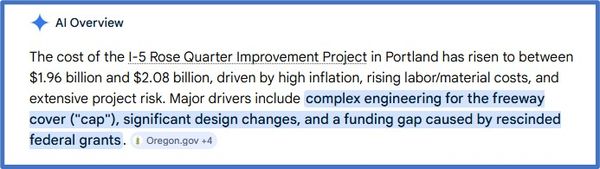
The above assessment of the cost of the I-5 Rose Quarter project estimates a total cost of this project of $2.0 billion. Axing the Rose Quarter project would reduce ODOT's debt service expenses by $130 million per year, about a third of the current shortfall in ODOT's operation and maintenance budget. (ODOT is short for Oregon Department of Transportation.)
Many of those living in the City of Portland oppose the Rose Quarter project entirely. In contrast, there seems to be a fair amount of support for adding lanes where possible to I-205. One way to possibly finance lane additions on I-205 is with tolls, tied to using these new lanes. A possibility for isolating the tolling of these additional lanes could be adding a new deck to I-205.
Adding a third freeway in the Portland Metro area crossing the Columbia seems nearly impossible, given existing urbanization of the Portland Metro area. But longer term, there are creative thoughts about constructing underground cargo freight lines between port hubs:
Overview
Get rid of the light rail part of the I-5 Bridge Replacement Project
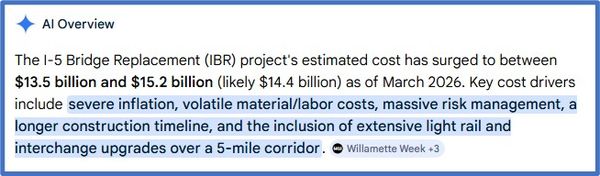
The I-5 Bridge Replacement project between Portland and Vancouver is a financial quagmire. Part of the cost of this project is its light rail addition from the Expo Center in Portland to downtown Vancouver.
This light rail component adds over a billion dollars in cost to the project. This light rail service only serves to replace the existing faster C-Tran bus service and is rather unnecessary. The real reason Metro and Vancouver City government want this light rail proposal is that it is actually an excuse to do urban renewal spending along the light rail line. Urban Renewal usually leads to tax increases for local jurisdictions, as it diverts public monies for basic services to paying for the urban renewal spending splurges of local city councils. With less funds for basic services, local city councils, then, most always turn around and ask voters for additional property tax levies.
The I-5 Bridge project should be sharply scaled back to just making the I-5 Bridge seismically sound.
Sharply reducing the I-5 bridge project this way could save another $150 million per year in ODOT's debt service expenses annually.
(posted by Elvis Clark on April 26, 2026)
Oregon's government budget grows faster than Oregon economy
When government grows faster than the economy it becomes a drag on economic prosperity
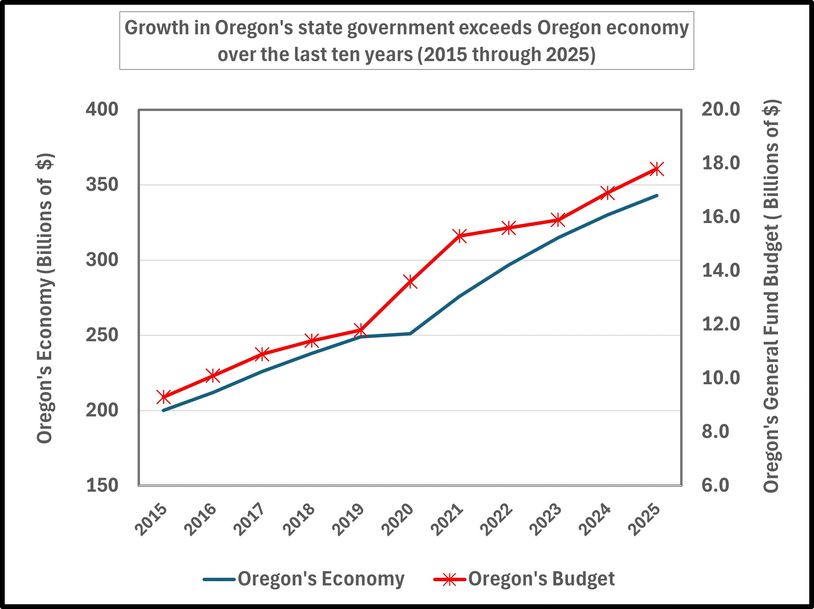
Over the last ten years, as shown in the chart above, Oregon's General Fund budget is growing at a rate of 6.7% per year (per Oregon Office of Economic Analysis data). Over the same ten years, the Oregon economy has grown only 5.5% per year (U.S Bureau of Economic Analysis data).
Oregon state government should limit the growth in its budget to just 5.5%, given that the Oregon economy is only growing at this rate. For the state government to grow faster than 5.5% per year, as yielded by the Oregon economy, the Oregon legislature constantly finds itself creating new taxes and fees, which are a drag on the economy and the economic prosperity of Oregonians.
If I were to be elected to the legislature, I would limit state agency budgets to growing slower, not to exceed the growth of the economy at its current rate growth of 5.5% per year. This would eliminate new taxes/fees while not cutting into Oregon's social safety net.
(posted by Elvis Clark on April 21, 2026)
read the "True Believer." it is healthy skepticism.
Oregon is beset by two religious movements currently, these being "climate change" and "Equity."
Oregon's elites force the costly implementation of net zero emission programs, "Climate Action;" and "Climate Change" has all the elements of a religion. Those who do not believe government funded "consensus" is science are labeled as "deniers." (The religious counterpart to Denier would be heretic.)
I have pointed out to Milwaukie's former Mayor and a current city councilor that Milwaukie's Climate programs are futile in significantly changing the temperature of the earth. But their response is not to deny that the City of Milwaukie's actions have no significant impact on changing the temperature of earth, but rather these politicians, instead, say that we in Milwaukie need to "sacrifice" for climate change.
Sacrifice is a religious like word. What the book "The True Believer," by Eric Hoffer (circa 1950s) conveys is that human beings are susceptible to aberrant mass movements. This is because human beings are not just self-interested beings but also want to have meaning in their lives. On the latter, human beings want to believe they are doing something that is greater than themselves, making them vulnerable to the slick politician who sells them on the pursuit of grandiose visions which even are costly, hurtful on the whole. "Climate Change" currently has crept into Oregon governments at all levels, even as these policies are costly and are robbing Oregon of economic prosperity and even as the government's climate programs are not having any significant measurable impact on changing the temperature of the earth or even global greenhouse emissions.
The Oregon politicians leading the Climate Change mass movement gain power, while corporate grifters are rewarded with public monies for questionable projects. These corporates/non-profits make bank off of climate change, recycling some of the public monies they are granted by the Climate Change politicians back into campaigns for re-electing these same politicians.
Those not caught up in the Climate Change movement tend to be individuals who are skeptics or agnostic, who do not want to give up their freedom and liberty to the Climate Change religious-like mass movement.
Similarly, "Equity" has also crept into our Oregon government institutions. Equity in its primacy is founded on the idea of guilt, another component of religion - "white privilege" being a key component of inculcating people with guilt (a guilt similar in nature to original sin). With Equity, you are no longer a unique individual, but part of a broad classification based on the arbitrariness of your skin color or ethnicity.
So, I highly recommend reading the book "The True Believer," by Eric Hoffer.
(posted by Elvis Clark on April 15, 2026)

Oregon's Climate programs said to be too extreme
Nigel Jaquiss of Willamette Week does a thorough job of critiquing Oregon's Climate Programs
Here is the link to Jaquiss' critique of Oregon's Climate Protection Program:
Oregon’s Climate Protection Program Costs Far More Than Other States’—and Is Far Less Accountable
(posted by Elvis Clark on April 3, 2026)

Portland's Decline explained in youtube video
My thoughts on restoring Portland after viewing this video
The "After Party" podcast by Emily Jashinsky has quite the following nationally. Here is her podcast called "How Portland Destroyed Itself From Within As Progressive Experiment Backfires:"
How Portland Destroyed Itself from Within as Progressive Experiment Backfires, with Mark Hemingway
I believe there are a lot of accurate points made about the decline of Portland, namely crime, homeless tents and too much taxation. I would add that remote working is also contributing to the decline of Portland's downtown.
Remote working is here to stay, but I believe downtown Portland could be made to shine again. I think it would take forcing the drug addicted roaming downtown to be confined to a treatment compound somewhere outside the city, where the addicted would have to go cold turkey off drugs. No Narcan except for overdose and emergency treatment. Do this for just a little while and word would get around to not come to Portland to live your life on Portland streets feeding your drug addictions.
Such a hard nose reality for the drug addicted would cause associated crime to drop.
The next thing is Portland needs to control protest crowds so that they don't smash and vandalize downtown businesses/properties.
For those who are not drug addicted but still living in tents and on the streets, these folks should be moved to designated compound areas with temporary quarters and probably there needs to be a separation by gender, youth, family. Women and children should not be forced to share quarters with single men. Transgender kind of muddies these waters so I am partial to using biology for classifications. Cannot have everything.
Lastly, Portland and Multnomah need to stop creating new taxes and live with what current taxes provide for city government operations.
Do these things and I think Portland, specifically downtown Portland, starts a true recovery.
(posted by Elvis Clark on March 27, 2026.)

Gamba helps ruin the electricity industry but blames others
It is absolutely insane that people let Gamba keep interfering in industries when he fails miserably
Oregon state representative and former Milwaukie Mayor Mark Gamba (photo to right) briefed the Milwaukie City Council on Tuesday January 6, 2026. He talked of his legislative proposals. He leads his briefing by saying that the state and local Portland areas are facing power outages, because ... because ... new electric transmission lines (accessing remote wind and solar farms) are not being built while electricity demand is growing at the same time.
For the last ten years, Gamba pushes to make our electricity supplies totally dependent on solar, wind, and energy storage batteries, eliminating existing and planned around-the-clock high-capacity base load power supplies provided by natural gas and coal power plants. Gamba had been assuming all along, erroneously, that new electric transmission lines would be built to access a diverse set of solar and wind farms (in what is called the Net Zero program).
I do not know who Gamba talks to in the electric industry, but most everyone with professional experience in the electric utility business could have told Gamba - when he started his interference in the electric utility industry ten years ago now - it takes literally decades and decades to build new electric transmission lines. Why? Because most people do not want transmission lines crisscrossing all over Oregon's horizon.
Gamba blames others for his failure to recognize that new transmission is nearly impossible to build.
The solution to expanding electricity supplies is known for some time now. It is building high efficiency natural gas power plants near urban areas where the demand for electricity is highest, or building natural gas power plants along existing transmission lines that can be more easily upgraded to carry more electricity supply. But state policy makers like Gamba denied utilities like PGE the ability to build these reliable power plants and instead, restricted electric utilities to depend solely on wind and solar farms that are not reliable enough to meet the hour-to-hour changes in electric energy demand.
Gamba cries that Oregon can't build new transmission lines like Texas, which he remarks added new transmission easily and added a lot of wind farms this last year. But if you look into his claim about Texas, you will find that Texas generates nearly two-thirds of its power with natural gas and coal. The main reason Texas adds wind this last year is probably because wind farms are heavily subsidized by the federal government and these subsidies end this year.
Gamba thinks he can help save us from power outages by getting people to let their electric utility remotely turn down their thermostat when it gets cold or turn down the air conditioner when it gets hot. But utility customers do not want their electric utility to manage their thermostats. Gamba calls utilities having control over residential thermostats "a virtual power plant." Again, Gamba is likely to fail at this also. People do not want to go cold when there is a cold snap, nor do they want to get overly hot when there is a heat wave.
Gamba is a perfect example of why politicians should not be allowed anywhere nears critical industries like the energy industry.
So, Gamba having broken the electric utility industry with his flowery, unrealistic visions of grandeur (that is, net zero) is now wanting the government to get into the business of manufacturing homes. Never mind there are already companies manufacturing homes. In fact, home manufacturing in the private sector is about to maybe take off, according to a recent Wall Street Journal article, eliminating the need for Gamba's home manufacturing gambit
Gamba seems to always be looking to add new taxes onto Oregonians to fund state government's continual expansion. He cries that Oregon has no sales tax, even though this ignores that Oregon has a Corporate Activities tax which is a backdoor sales tax - as it taxes corporate sales and not net profits.
(posted by Elvis Clark on January 9, 2026)

Dr. Eric Fruits says kotek's prosperity, just for the Show
Economics professor Dr. Fruits, says most prosperity plans by Oregon Governors aren't followed
Fruits says Oregon's key economic centers, Multnomah County and City of Portland, are faltering because of high tax and deteriorating quality of life, causing high end taxpayers to flee the County and City.
Fruits also says Oregon's public employee pension system's financial deficit is a drag on city and county government service funding.
(Speaking locally - MIlwaukie, Or -about this: You know the City Council of Milwaukie is always bemoaning the Oregon constitutional limits on property tax increases, but when the Council says Milwaukie property taxpayers should pay more, there is little, to no mention, of the drain on the City of Milwaukie's budget imposed by the state of Oregon to save the Oregon public employee retirement system (PERS). Governments in Oregon are just as greedy as self-interested business owners and customers. But at least business owners and customers have to earn it by offering goods and services in exchange for dollars - government gets your tax monies regardless of performance. And how is it that in a year (2024) when the stock market booms with 20 % plus return, Oregon PERS earns only 6%. Oregon needs to go to a defined contribution retirement system (individual 401ks) and stop with the defined benefit plan.)
Here's DR. Fruits critiqued of Governor Kotek's "prosperity" dog and pony show:
Graphic details Kotek’s Prosperity Roadmap flaws | Oregon Catalyst
(maybe the Governor means more prosperity for government employees and those "non-profit" administrators making bank from government subsidies - not so much for Oregonians in general.)
(posted by Elvis Clark on December 6, 2025)

Economics professor, consultant says Portland in doom loop
Says Portland has 2 to 5 years to stabilize, before its doom loop becomes irreversible
Dr. Eric Fruits (photo to right) explains the factors which are putting Portland (Or) into an economic and social decline in the following Oregon Catalyst article link:
Economist: 9 factors in Portland’s doom loop | Oregon Catalyst
I might add to Fruits' analysis that Milwaukie is likely to suffer with much of the rest of the state if Portland continues declining. Ironically, Milwaukie benefitted from Portland's entry into a doom loop, as people moved out of Portland and relocated to Milwaukie and Clackamas County.
But now housing prices in Milwaukie have moved up sharply, and this is dampening in-migration of the middle- and upper-income classes to Milwaukie. Ironically, Milwaukie City Council is encouraging people of limited means to move into Milwaukie, and in these cases the City collects less monies per resident to supply basic services, like police.
(posted by Elvis Clark on November 22, 2025)
No surprise: more spending on homeless begets more homeless
The latest homeless count in Portland area shows 61% increase in homeless

Since 2023 through this last January, homelessness in the Portland Metro area (less Vancouver, Wa) is reported to have increased over 60%. And this is despite taxpayers having forked over $1.3 billion to supposedly address the problem.
You can read more in depth about this surge in homelessness in the Willamette Week:
Metro-Area Homelessness Persists Despite $1.3 Billion Raised Since 2021, Point-in-Time Count Shows
One aspect of the Willamette Week's numbers is how many of the homeless are from out of the region. Willamette Week says survey says only 17%. First of all, that is still a substantive part of the problem. I also think the number is probably low, as I have heard from former Mayor Wheeler that the number is closer to 30%.
For any one city or region, there is an infinite supply of homeless folks from other regions, states and even countries that can and will come to Portland because it provides free government handouts/assistance in many forms to the homeless without asking for anything in exchange.
You even have "non-profit" government funded organizations (NGOs) handing out free needles to the many homeless that are drug addicted.
Elon Musk refers to NGOs as "Drug Zombie Farmers."
The incentive for NGOs is to never reduce homelessness, but rather to grow it.
As the Nobel prize winning economist, Milton Friedman, once says: "When you start paying people to be poor, you wind up with an awful lot of poor people."
(posted by Elvis Clark on November 6, 2025)
Meanwhile those paying taxes so government can splurge on homeless NGOs, close up shop

Deadshot Bar serving the Ladds Addition neighborhood of Portland says it is closing permanently because of Portland's high costs of doing business (including taxes and fees).
Portland voters just approved in this last Tuesday's special election a property tax hike for parks of some $180 or so per year.
Governments in Oregon need to tighten their budgets, because all their spending on non-core functions is squeezing out the productive parts of the economy.
There have been other recent Portland business closures, as reported in the following link to the Oregon Catalyst: What the restaurant said as they closed for good | Oregon Catalyst
Former EcoNorthwest president says oregon is stagnate
EcoNorthwest is an economic consulting firm that often does studies for Oregon governments

Here's the Eugene Register Guard's reporting on this economic expert's opinion about the current state of Oregon's economy (and it ain't great):
A leading observer of Oregon’s economy sees a state off course - Lookout Eugene-Springfield
What strikes about this opinion is one of the negative factors cited as gripping Oregon is an "an ambivalence about growth."
(posted by Elvis Clark on September 14, 2025)
Economics professor fruits explains oregon's doomloop
High taxes and stiff regulations are causing capable Oregonians to flee Oregon - a big problem!
Here's some excerpts from Dr. Eric Fruits's assessment of the declining state of Oregon and its major urban area, Portland:
" Unfortunately, we don’t have serious people in policy positions. We’ve seen a two-decade decline, and no one in power has taken serious steps to reverse it. Instead, we have “blue ribbon” committees, work groups, and task forces that excel at producing PowerPoints, but fail at reversing—or even slowing—the decline. "
" It’s too late to elect a new captain when the ship takes on water. At that point, the best option is to head for the lifeboats and float to the closest island. The people and businesses with options are leaving. It’s not the best thing for Oregon, but it’s the best thing for them. Unfortunately, those taxpayers and job creators are precisely the people we need to bail out the ship. Once they’ve jumped, they aren’t looking back. "
Here's Dr. Fruits full writing on Oregon's economic doom loop:
7 dire economic warnings for Oregon | Oregon Catalyst
(posted by Elvis Clark on August 7, 2025)

Oregon is about to pay striking public employees to strike
Public Employee Unions give big to politicians in Oregon and in return get more taxpayer monies

Oregon Senate Bill 916 described in the above panel by OPB will, if enacted, pay public employees like teachers and bureaucrats unemployment benefits while they go on strike.
This makes it a lot easier for public employees to strike and walk off the job, as they get like a strike-paid-vacation, receiving a check for unemployment while choosing to strike their government employer. School Districts would have to pay more into the state's unemployment Compensation fund, and hence, School Districts even oppose this Oregon Senate Bill.
Why is it hard to understand that Oregon is just encouraging bad government behavior with bills like this Senate Bill 916? When will the Oregon electorate ever get a clue that they are being hosed by those holding elected office who pretend that they are helping?
Imagine if you're a parent with children in your local public school, and your school shuts down because of a teacher strike and now with this new state law (likely to be enacted) you get your life turned upside down while the striking teachers get to do a 'strike-party' while getting a check while they party.
Oregon's governance is like a cruel joke.
(posted by Elvis Clark on May 29, 2025)